
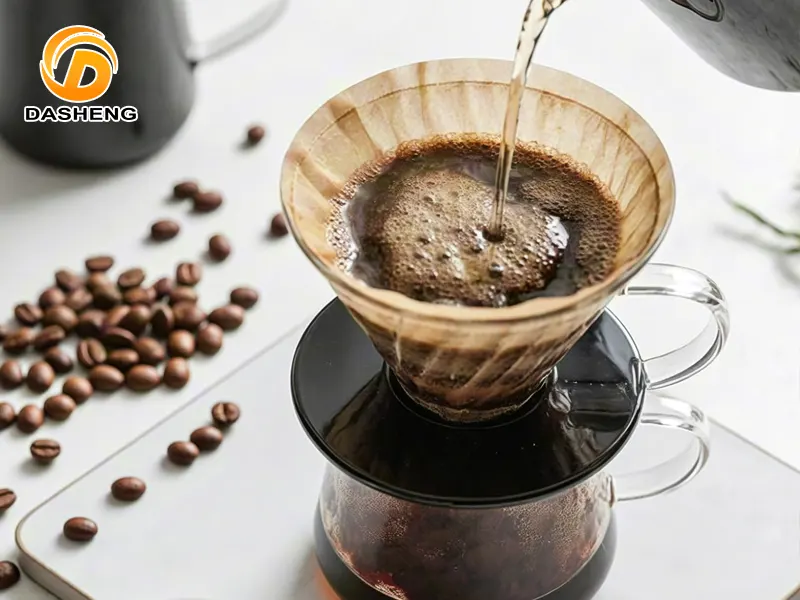
Hand-poured coffee is a magical thing for many novice coffee lovers. So if you want to brew coffee by yourself, where should you start? This article will introduce brewing techniques and introduce as many hand-poured coffee machines as possible.
Most people do not know the principle of hand-poured coffee, and their technique is unstable when brewing, resulting in over-extraction and under-extraction. Today we will talk about some suggestions and techniques for hand-poured coffee. However, no matter how much theoretical knowledge you know, practice is still indispensable. Dasheng believes that you can first clarify the principle of hand-poured coffee and clarify the purpose of hand-poured coffee. Then, you can apply and implement it in practice. The most important thing is to practice more to gradually stabilize. Novices will gradually become old water and brew coffee that they are satisfied with.
When making hand-poured coffee, the three most important factors are:
Water quality
Fresh coffee beans
Utensils and filter cups
However, every detail is crucial. Keeping the grinding coarseness consistent, using the right measurement unit, and using the right water temperature can improve the taste of coffee.
Water quality
The importance of high-quality water for brewing coffee cannot be overemphasized. It keeps your equipment in good condition and allows your coffee to reach its full potential. It is recommended to use filtered water or purified water to brew coffee. Of course, mineral water is also OK. However, each type of water will taste slightly different when brewed with the same brewing parameters. Dasheng has also conducted experiments for this. (This experiment is not to prove which water quality is better for brewing coffee, but to show the difference in the extraction flavor of different water qualities, for your reference)
| Project | Details |
|---|---|
| Brewing parameters | |
| Amount of coffee powder | 15 grams |
| Ratio | 1:15 |
| Water temperature | 91 degrees Celsius |
| Grinding degree | 0.85mm screen pass rate 80% |
| Filter cup | v60 #01 filter cup |
| Brewing process | |
| First stage of water injection | 30 grams of water, steam for 30 seconds |
| Second stage of water injection | Inject 95 grams of water (electronic scale shows 125 grams), injection is completed in about 1 minute and 05 seconds |
| Third stage of water injection | Inject 100 grams of water (electronic scale shows 225 grams), injection is completed in about 1 minute and 40 seconds |
| Extraction time | 2 minutes, remove the filter cup to complete the brewing |
Experimental Results
| Purified water brewing | Mineral water brewing | Filtered water brewing | |
| Flavor description | Full acidity, highest acidity, clean, high sweetness, almost no fermentation feeling | High cleanliness, complex and diverse taste, almost no fermentation feeling | Complex, berry and stone fruit, tea-like astringency and slight fermentation aftertaste |
Water quality directly affects the taste, aroma, consistency and many other health factors of all coffees. The key influencing factor is the mineral composition in the water. Mineral ions such as calcium, magnesium, sodium and potassium in the water will affect the thermodynamic extraction ability of coffee, thus causing changes in the flavor of coffee.
Fresh coffee beans
When you buy freshly roasted coffee beans, the flavor of the roasted coffee beans will gradually weaken. The freshly roasted beans need to be aged for 4-7 days, and the flavor of the coffee will be at its best at this time. High-quality, fresh coffee beans (we prefer beans from Guatemala and Ethiopia)。
Utensils and filter cups
Beginners need to find a set of utensils that suit them. Essentials include:
Hand-brewed coffee pots, including flat-mouthed pots, palace pots, pointed crane-bill pots, etc. However, for hand-brewed coffee pots, it is recommended that beginners use a kettle with a gooseneck spout. Its water flow is easier to control, and there will not be too much water flow during the brewing process, which is easy to use.
For coffee filter cups, try to use bleached filter paper. Unbleached filter paper is prone to odor; use the same type of filter paper for the filter cup. Use 01 filter paper for 01 filter cups, and 01 or 02 filter paper for 02 filter cups.
Coffee grinders, the degree of grinding will directly affect the concentration and extraction rate of coffee, and it is also one of the factors affecting hand-brewed coffee, which is very important.
Finely ground coffee will have a high concentration, high extraction rate, and high body (easy to over-extract).
Coarsely ground coffee will have a low concentration, low extraction rate, and low body (easy to under-extract).
Medium-fine grinds (like the size of granulated sugar) are generally suitable for hand-brewed coffee.

Electronic scales
Can help accurately measure the weight and extraction time of coffee. The taste and strength of coffee mainly depends on the ratio of coffee beans to water. Using a timer electronic scale can help master the ratio of coffee beans and water, ensuring that the taste and flavor of each cup of coffee are consistent, thereby improving the quality and taste of coffee.
Water temperature
SCA says that the ideal temperature range for brewing coffee is 195°F–205°F (90.5°C–96°C) when the water contacts the ground coffee. Other professionals say that just boiled water (212°F/100°C) works best. No matter which brewing temperature you choose, stability is important, so preheat the coffee machine thoroughly to ensure that you don’t lose too much heat too quickly.
Hand-brewed coffee water injection
1. (Start timing first) Steam with 30 grams of water until the timer is 30 seconds. When you see no bubbles expanding on the surface of the coffee powder, it means that the steaming is over.
2. Use a small stream of water to slowly pour water around the center until 125 grams (the timing time is about 1’00), and then divide it into sections to let the coffee powder soak slightly to make the extraction more uniform.
3. When the water level drops by 2/3, use a large stream of water to quickly pour until 225 grams (the time to stop pouring water is about 1’50), and the coffee liquid extraction time ends at about 2’00-2’10.
For beginners, if you want to get a cup of coffee with rich layers, you might as well practice this method continuously to brew out the flavor you like.